Imagine planting a tree.
You water it.
You give it sunlight.
You take care of it every day.
The next morning, you don't expect a giant tree to appear.
SEO works the same way.
One of the most common questions business owners, bloggers, and marketers ask is:
"How long does SEO take to show results?"
It's a fair question.
After investing time, money, and effort into SEO, everyone wants to know when the results will arrive.
The challenge is that SEO isn't like paid advertising where traffic appears instantly.
Instead, SEO is a long-term strategy that builds momentum over time.
The good news?
When SEO starts working, the results can continue for months or even years.
This guide will explain exactly how long SEO takes, what affects timelines, and how you can accelerate your progress.
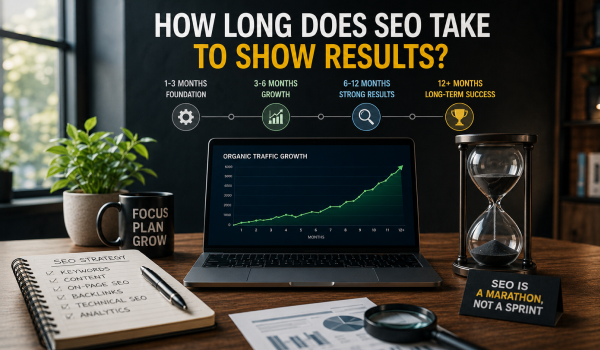
Most websites begin seeing noticeable SEO improvements within 3 to 6 months. However, meaningful business results such as significant traffic growth, leads, and rankings often take 6 to 12 months or longer depending on competition, website authority, content quality, and SEO strategy.
Many people assume SEO is simply adding keywords to a webpage.
In reality, search engines need time to:
Google doesn't immediately trust new content.
It evaluates signals over time before rewarding websites with stronger visibility.
This process protects search quality and helps users find reliable information.
During the first month, most SEO work happens behind the scenes.
Activities often include:
Minimal ranking changes.
Most work focuses on preparation.
This stage involves implementation.
Typical activities include:
You may notice:
Traffic growth is often limited at this stage.
This is when many businesses begin seeing meaningful movement.
Google has had time to evaluate your content and improvements.
For many businesses, this is the first stage where SEO feels rewarding.
By now, your content library and authority are growing.
If executed correctly, SEO gains often accelerate.
This is often where businesses begin seeing measurable ROI.
Websites that consistently invest in SEO often achieve compounding growth.
Established websites often rank faster because search engines already trust them.
New websites usually require more time.
Authority acts like a reputation score.
Trusted websites often see faster SEO gains.
Competitive industries take longer.
Examples include:
Less competitive niches often produce quicker results.
High-quality content performs better than thin or generic articles.
Google prioritizes content that:
Ranking for:
"best laptop"
is much harder than ranking for:
"best laptops for graphic designers under $1000"
Long-tail keywords often produce faster wins.
Technical issues can slow progress significantly.
Common issues include:
Backlinks remain a major ranking factor.
Websites with stronger backlink profiles often achieve faster results.
Google rewards content that matches user intent.
Even perfectly optimized pages may struggle if they fail to answer user needs.
SEO is not a one-time task.
Websites that consistently publish content and improve performance typically grow faster.
Local SEO often produces faster results because competition is usually lower.
For example:
A local bakery may rank faster than a national eCommerce brand competing across the country.
| Factor | New Website | Established Website |
| Trust Level | Low | Higher |
| Indexing Speed | Slower | Faster |
| Authority | Limited | Existing |
| Ranking Speed | Slower | Faster |
| Typical Results | 6–12 Months | 3–6 Months |
Content remains one of the strongest SEO assets.
Focus on solving real user problems.
Less competitive keywords often deliver faster rankings.
Prioritize:
Focus on quality over quantity.
Internal links help search engines discover and understand content.
Sometimes updating existing pages produces faster results than publishing new content.
Reality:
Meaningful SEO improvements require time.
Reality:
User-focused content matters more than keyword repetition.
Reality:
SEO requires ongoing optimization and maintenance.
Most websites see initial improvements within 3–6 months, while substantial traffic and lead growth often take 6–12 months.
SEO requires time for crawling, indexing, trust building, content evaluation, and authority development.
You may see early signs such as improved indexing and impressions, but significant results are uncommon within one month.
Focus on high-quality content, technical optimization, long-tail keywords, backlinks, and consistent publishing.
In many cases, yes. Local competition is often lower than national competition.
New websites often require 6–12 months to achieve meaningful organic growth.
No. Paid advertising delivers immediate traffic, while SEO focuses on long-term sustainable growth.
So, how long does SEO take to show results?
While every website is different, most businesses begin seeing meaningful improvements within three to six months, with stronger growth occurring between six and twelve months.
SEO is not a shortcut.
It's a long-term investment that builds authority, trust, visibility, and sustainable traffic over time.
The businesses that succeed with SEO aren't necessarily the ones that move fastest. They're the ones that stay consistent.
If you're investing in SEO today, focus on quality content, user experience, and long-term value. The results may take time, but they can become one of the most valuable assets your business ever builds.