

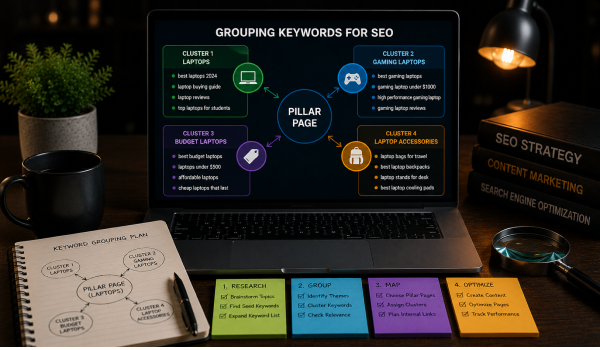
Finding keywords is only the first step in SEO.
Many website owners spend hours collecting hundreds of keywords but struggle to organize them into an effective content strategy. As a result, they create overlapping content, target the wrong keywords, and miss valuable ranking opportunities.
This is where keyword grouping becomes important.
Learning How to Group Keywords for SEO helps you organize related search terms into logical clusters, create stronger content, avoid keyword cannibalization, and improve your chances of ranking for multiple keywords with a single page.
Modern SEO is no longer about creating one page for every keyword variation. Search engines understand topics, context, and user intent. Grouping related keywords allows you to create comprehensive content that satisfies both users and search engines.
In this guide, you'll learn exactly how to group keywords for SEO and build a content strategy that scales.
To group keywords for SEO, collect related keywords, analyze search intent, identify keyword similarities, create topic-based clusters, choose a primary keyword for each group, and build content that targets the entire cluster rather than individual keywords.
Keyword grouping is the process of organizing related keywords into clusters based on shared topics, search intent, and semantic relevance.
Instead of targeting every keyword with a separate page, keyword grouping allows multiple related keywords to be targeted within a single piece of content.
For example:
| Separate Keywords |
| SEO Guide |
| SEO Tutorial |
| Learn SEO |
| SEO Basics |
| SEO for Beginners |
These keywords share similar intent and can often be grouped into one comprehensive article.
Keyword grouping improves content quality and helps search engines understand the topic more effectively.
Modern search engines can rank a single page for hundreds of related search queries. Grouping keywords allows content to target an entire topic rather than a single phrase.
This increases ranking opportunities and improves organic visibility.
Google understands relationships between words, phrases, and concepts. Grouping related keywords naturally aligns with how search engines interpret content today.
When multiple pages target nearly identical keywords, search engines may struggle to determine which page should rank.
Keyword grouping helps consolidate authority into a single page rather than spreading ranking signals across several similar pages.
Instead of publishing multiple thin articles, grouping keywords encourages comprehensive content creation that provides greater value to users.
Keyword grouping transforms a large list of keywords into manageable topic clusters. This makes editorial planning, content creation, and SEO management significantly easier.
Years ago, SEO relied heavily on exact keyword matching. Today, Google uses machine learning and semantic analysis to understand topics rather than individual keyword variations.
For example:
may trigger similar search results because Google understands they are closely related.
Google prioritizes content that satisfies user intent. If several keywords share the same intent, they often belong in the same content cluster.
Start by gathering keywords from multiple sources.
Popular sources include:
The goal is to create a comprehensive list before organizing keywords into groups.
Search intent is one of the most important factors in keyword grouping.
Ask:
Keywords with different intent generally require separate pages.
Many keywords use different wording but express the same idea.
Example:
| Keyword |
| SEO Guide |
| SEO Tutorial |
| Learn SEO |
| SEO Basics |
These keywords can often be grouped because they address the same topic.
Once similarities are identified, create keyword clusters.
Example:
| Cluster | Keywords |
| SEO Basics | SEO Guide |
| SEO Basics | Learn SEO |
| SEO Basics | SEO Tutorial |
| SEO Basics | SEO for Beginners |
Each cluster should represent a distinct topic.
Each keyword group should have one primary keyword that serves as the main focus of the page.
Choose a keyword based on:
Supporting keywords naturally reinforce the topic.
Rather than optimizing for one keyword repeatedly, create content that addresses all keywords within the cluster.
This improves topical authority and ranking potential.
Topic-based groups contain keywords related to a specific subject.
Example:
| Topic | Keywords |
| Keyword Research | Search Volume |
| Keyword Research | Keyword Difficulty |
| Keyword Research | Long-Tail Keywords |
These groups support content hubs and topic clusters.
Keywords can also be grouped based on user intent.
| Intent | Example Keywords |
| Informational | What is SEO |
| Commercial | Best SEO Tools |
| Transactional | Buy SEO Software |
| Navigational | Ahrefs Login |
Intent-based grouping helps determine content format.
Grouping keywords by funnel stage supports conversion-focused SEO strategies.
| Funnel Stage | Example Keyword |
| Awareness | What is SEO |
| Consideration | Best SEO Tools |
| Decision | Buy SEO Software |
Primary Keyword:
SEO Guide
Supporting Keywords:
One comprehensive page can effectively target all these keywords.
Many marketers confuse keyword grouping with keyword mapping.
| Factor | Keyword Grouping | Keyword Mapping |
| Purpose | Organize Keywords | Assign Keywords |
| Focus | Clusters | Pages |
| Stage | Planning | Implementation |
| Output | Keyword Groups | URL Targets |
| Benefit | Content Organization | SEO Structure |
Keyword grouping happens first. Keyword mapping then assigns each keyword group to a specific page on your website.
Together, they create a structured SEO strategy.
Keywords with similar wording may still require different pages if the intent differs.
Always review search results before grouping keywords.
If the same pages rank for multiple keywords, those keywords likely belong in the same group.
This is one of the most reliable grouping methods.
Each cluster should focus on a clearly defined topic. Large unrelated groups can weaken content relevance.
Similar wording does not always indicate similar intent. Always analyze search results before clustering keywords.
Intent should be the primary factor when determining keyword groups.
Over-segmentation often leads to thin content and missed ranking opportunities.
Large clusters can make content unfocused and difficult to optimize effectively.
| Step | Action |
| 1 | Build Keyword List |
| 2 | Analyze Search Intent |
| 3 | Identify Similar Keywords |
| 4 | Create Keyword Clusters |
| 5 | Select Primary Keywords |
| 6 | Map Clusters to Pages |
| 7 | Create Content |
| 8 | Monitor Rankings |
Start by collecting keywords, analyzing search intent, identifying related terms, creating keyword clusters, selecting primary keywords, and building content around each cluster.
Keyword grouping is the process of organizing related keywords into clusters based on topic relevance and search intent.
Keyword grouping helps improve rankings, strengthen topical authority, simplify content planning, and prevent keyword cannibalization.
There is no fixed number. A cluster may contain a few keywords or dozens of related terms, depending on topic complexity.
Yes. Keyword grouping helps pages rank for multiple related queries while improving content relevance and user experience.
Understanding How to Group Keywords for SEO is essential for creating a scalable and effective content strategy.
Rather than targeting every keyword individually, keyword grouping helps organize related terms into meaningful clusters based on topic relevance and search intent. This approach improves rankings, strengthens topical authority, simplifies content planning, and prevents keyword cannibalization.
By combining keyword research, search intent analysis, SERP evaluation, and topic clustering, you can build content that ranks for multiple keywords while delivering greater value to users.
As SEO continues to evolve toward topic-based relevance, keyword grouping will remain one of the most important skills for long-term organic growth.