


How to use keywords naturally? Place your primary keyword in important SEO elements like the title, introduction, headings, URL, and conclusion while writing naturally for readers. Support it with related keywords, avoid keyword stuffing, and ensure every keyword fits the context of your content.
Keywords remain one of the most important parts of search engine optimization, but the way you use them has changed significantly. Modern search engines no longer reward content that repeats the same keyword over and over. Instead, they prioritize content that answers user questions naturally and comprehensively.
Learning How to Use Keywords Naturally helps you create content that satisfies both search engines and readers. Natural keyword placement improves topical relevance without making your writing sound repetitive or forced. It also enhances readability, increases user engagement, and supports long-term SEO performance.
Many beginners either underuse keywords or overuse them in an attempt to rank higher. Both approaches can hurt your SEO efforts. The goal is to create valuable content where keywords fit seamlessly into the flow of the text.
In this guide, you'll learn where to place keywords, how often to use them, common mistakes to avoid, and proven techniques to write naturally while improving your search rankings.

Using keywords naturally means incorporating your target keyword into content where it makes sense for the reader instead of forcing it into every sentence. Your content should flow naturally, answer user intent, and maintain readability while signaling the page's topic to search engines.
Rather than focusing on repeating the exact keyword, modern SEO encourages using related terms, synonyms, and contextually relevant phrases. This helps search engines understand your topic more comprehensively.
There's a significant difference between optimizing content and over-optimizing it.
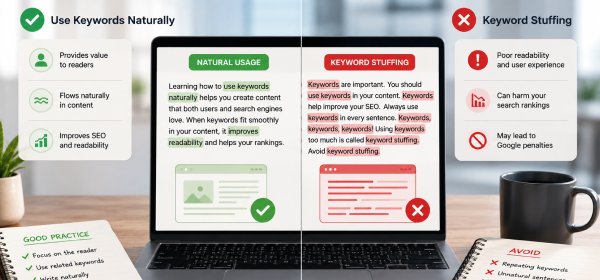
Natural Example:
Learning how to use keywords naturally helps improve SEO while making your content easier to read.
Keyword Stuffing Example:
How to use keywords naturally is important because how to use keywords naturally improves SEO if you know how to use keywords naturally correctly.
The first example sounds conversational, while the second feels repetitive and unnatural.
Search engines aim to provide users with the most helpful content. If your article is difficult to read because of excessive keyword repetition, visitors may leave quickly, reducing engagement signals.
Writing naturally improves the user experience and increases the likelihood that readers will stay on your page, explore related content, and trust your expertise.
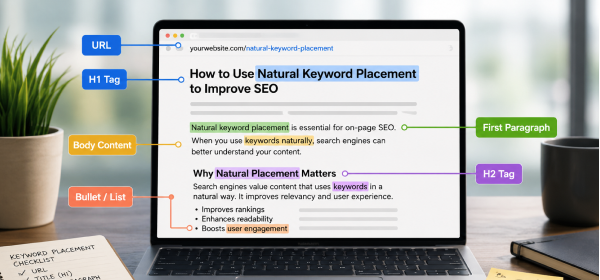
Natural keyword placement benefits both search engines and readers. It allows search engines to understand your topic without compromising the quality of your writing.
When keywords appear in meaningful locations, search engines can better identify the primary topic of your page. Combined with semantic keywords and comprehensive content, this strengthens topical relevance.
Instead of relying on repetition, focus on providing complete answers to user queries.
Readers want informative, engaging content—not articles overloaded with repetitive keywords. Natural writing makes your content easier to understand and more enjoyable to read.
This often leads to longer session durations, lower bounce rates, and better overall engagement.
Search engines have become increasingly effective at identifying manipulative SEO practices. Excessive keyword repetition can make content appear spammy and may reduce its effectiveness.
Using keywords naturally helps maintain a healthy balance between optimization and readability.
Modern search engines no longer rely solely on exact-match keywords. They use advanced language processing to understand context, relationships between words, and user intent.
Semantic search allows search engines to understand the meaning behind a query instead of matching exact words.
For example, an article about how to use keywords naturally may also rank for related searches like:
Using related phrases strengthens your content without repeating the same keyword excessively.
Search engines prioritize content that satisfies the user's intent. Before adding keywords, identify whether the search is informational, commercial, transactional, or navigational.
Content aligned with search intent generally performs better than content that simply repeats target keywords.
Google evaluates how comprehensively a page covers a topic. Articles that naturally include supporting concepts, related terms, and practical examples often demonstrate stronger topical authority.
Instead of writing for one keyword, focus on answering every important question related to the topic.
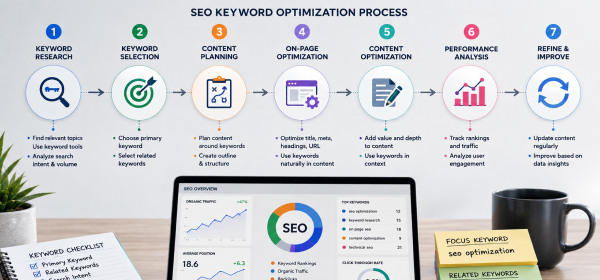
Keyword placement matters because certain page elements carry more SEO weight than others.
Include the primary keyword near the beginning of your SEO title whenever possible. This immediately communicates the page topic to both users and search engines.
Example:
How to Use Keywords Naturally: 15 Proven Tips for Better SEO Rankings
Your H1 should clearly describe the topic while naturally including the focus keyword. Every page should have only one H1.
A concise, descriptive H1 improves both readability and SEO.
Mention the primary keyword within the first 100 words of the introduction. This helps establish the page's relevance early without making the content feel forced.
Use the keyword once or twice naturally rather than repeating it unnecessarily.
Include your focus keyword or related variations in selected H2 and H3 headings where they genuinely fit the topic.
Supporting keywords can also be used to expand topical coverage without excessive repetition.
Write a compelling meta description that includes the primary keyword naturally while encouraging users to click.
Although meta descriptions are not direct ranking factors, they influence click-through rates.
Keep URLs short, descriptive, and keyword-focused.
Good Example:
yourdomain.com/how-to-use-keywords-naturally
Avoid unnecessary numbers, dates, or random characters.
Describe images accurately while including the focus keyword only when it genuinely reflects the image.
This improves accessibility and provides additional relevance signals for search engines.
Mention the primary keyword naturally in your conclusion to reinforce the page's topic while summarizing the key points.
Avoid forcing additional keyword repetitions if they don't fit naturally.
Following proven SEO practices helps you optimize content without sacrificing readability.
Always prioritize the user experience. Write naturally, answer questions clearly, and solve the reader's problem before thinking about keyword frequency.
Content that genuinely helps readers is more likely to earn engagement, backlinks, and higher rankings over time.
Instead of repeating the exact keyword throughout the article, include related terms and semantic variations.
For example, alongside How to Use Keywords Naturally, you might use:
This creates richer, more comprehensive content.
There is no perfect keyword density, but a practical guideline is to keep the focus keyword around 1–1.5% of the total word count.
The keyword should appear only where it adds value. If a sentence sounds awkward after adding a keyword, rewrite it instead of forcing the phrase.
A simple way to identify unnatural keyword usage is to read your content aloud. If repeated keywords make the text sound robotic or repetitive, revise those sections.
Natural, conversational writing is easier for users to understand and aligns better with modern SEO practices.
| SEO Element | Include Primary Keyword? | Priority |
|---|---|---|
| SEO Title | ✅ Yes | High |
| H1 Heading | ✅ Yes | High |
| URL Slug | ✅ Yes | High |
| Meta Description | ✅ Yes | High |
| First 100 Words | ✅ Yes | High |
| At Least One H2 | ✅ Yes | High |
| Relevant H3 | ✅ When Appropriate | Medium |
| Image ALT Text | ✅ Naturally | Medium |
| Conclusion | ✅ Yes | Medium |
| Throughout Content | ✅ Naturally | High |
Understanding the difference between natural keyword usage and exact-match keyword usage helps you create content that is both user-friendly and SEO-friendly.
| Factor | Natural Keywords | Exact Match Keywords |
|---|---|---|
| Definition | Keywords used naturally within the content | The exact keyword phrase is repeated as written |
| Readability | High | Can become repetitive if overused |
| User Experience | Excellent | May feel forced |
| SEO Value | Strong when combined with semantic SEO | Useful in key locations but shouldn't be overused |
| Best Practice | Use throughout the content naturally | Use in strategic SEO elements like the H1 and SEO title |
The best SEO strategy combines exact-match keywords in important locations with natural variations throughout the article.
Not every keyword on a page has the same purpose. A balanced keyword strategy improves topical relevance and helps search engines understand your content more effectively.
| Keyword Type | Purpose | Example |
|---|---|---|
| Primary Keyword | Main topic of the page | How to Use Keywords Naturally |
| Secondary Keywords | Support the main keyword | Natural keyword placement, SEO keyword optimization |
| Semantic Keywords | Related concepts and phrases | Search intent, content optimization, keyword relevance |
| Long-Tail Keywords | More specific search queries | How to use keywords naturally in blog posts |
| Question Keywords | Match common user searches | How many keywords should I use in an article? |
Using a mix of these keyword types creates comprehensive content without repeating the same phrase excessively.
Following simple best practices can significantly improve the quality of your content.
| Do | Don't |
|---|---|
| Write for people first | Write only for search engines |
| Use keywords naturally | Force keywords into every sentence |
| Include semantic keywords | Repeat the exact keyword unnecessarily |
| Match search intent | Ignore what users actually want |
| Review readability before publishing | Publish without proofreading |
| Use descriptive headings | Stuff keywords into every heading |
| Keep content conversational | Make the article sound robotic |
Keyword stuffing occurs when the same phrase is repeated too frequently in an attempt to manipulate rankings. This makes the content difficult to read and provides a poor user experience.
Instead of increasing rankings, keyword stuffing can reduce content quality and weaken your overall SEO performance.
Adding keywords without understanding why users are searching rarely produces good results. If your content doesn't answer the user's question, keyword optimization alone won't help.
Always identify the search intent before creating content.
Every heading doesn't need to include the exact focus keyword. Doing so creates repetitive content and reduces readability.
Use related phrases and supporting keywords where appropriate to keep your headings varied and natural.
Semantic keywords help search engines understand your topic more completely. Articles that include related concepts often perform better than those relying only on exact-match keywords.
Expand your content naturally by answering related questions and covering supporting topics.
Images are another opportunity to reinforce your content's topic. Use descriptive filenames and ALT text while including the focus keyword only when it accurately describes the image.
Avoid stuffing keywords into every image ALT attribute.
One of the biggest mistakes is forgetting that real people will read your content. Articles written only to satisfy search engines often feel unnatural and fail to engage readers.
Focus on creating useful, trustworthy, and well-structured content first. SEO should support the user experience—not replace it.
The best way to use keywords naturally is to include them where they fit logically within the content. Place the focus keyword in the title, H1, introduction, selected headings, and conclusion while using related keywords throughout the article.
There is no fixed number. A keyword density of around 1–1.5% is a practical guideline, but readability should always come first. If a keyword feels forced, use a related phrase instead.
Yes. Keyword stuffing makes content difficult to read and can reduce the overall quality of your page. Modern search engines reward helpful, natural writing rather than excessive keyword repetition.
No. Include the focus keyword in the H1 and at least one relevant H2. Use supporting and semantic keywords in other headings to maintain variety and improve topical coverage.
Yes. Semantic keywords help search engines understand your content's context and relationships between topics. They also make your writing sound more natural.
Yes. Search engines understand synonyms, related terms, and context. Comprehensive content with strong topical relevance can rank well without excessive exact-match keyword repetition.
It's often better to write naturally first and then optimize your content. This approach reduces the risk of awkward wording and helps maintain a conversational tone.
Absolutely. Search engines continue to prioritize helpful, user-focused content. Natural keyword placement combined with strong topical authority remains a core SEO best practice.
Learning How to Use Keywords Naturally is essential for creating content that ranks well while providing a great experience for readers. Instead of focusing on repeating the same phrase, prioritize answering user questions, maintaining readability, and covering the topic comprehensively.
Use your primary keyword strategically in important SEO elements such as the title, H1, introduction, headings, and conclusion. Support it with semantic keywords and related phrases to strengthen topical relevance without making your writing feel repetitive.
As search engines become more sophisticated, natural language, search intent, and high-quality content continue to play a greater role in SEO success. By following the techniques covered in this guide, you can improve your rankings, increase organic traffic, and create content that delivers lasting value to both users and search engines.






[…] guide explains URL Structure Best Practices, including URL length, keywords, hyphens, folders, parameters, redirects, canonical URLs, and common mistakes to […]