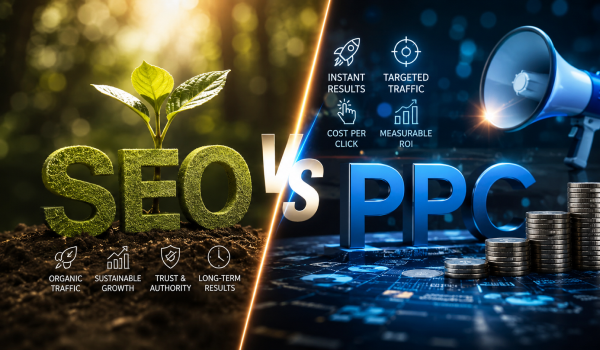
Businesses looking to increase online visibility often face a common question: SEO vs PPC—which is better? While both strategies can drive traffic and generate leads, they differ significantly in cost, speed, and long-term value.
SEO focuses on improving a website's organic search rankings to attract free traffic from search engines. PPC, or Pay-Per-Click advertising, allows businesses to pay for prominent ad placements and gain immediate visibility.
Choosing between SEO and PPC isn't always straightforward. Some businesses need fast results, while others prioritize sustainable growth and lower acquisition costs. Understanding how each strategy works can help you make a smarter marketing decision.
This guide compares SEO vs PPC, highlights their key differences, advantages, and limitations, and helps you determine which approach is best for your business goals.
SEO (Search Engine Optimization) focuses on improving organic rankings in search engines to generate free, long-term traffic. PPC (Pay-Per-Click) is a paid advertising model where businesses pay each time someone clicks their ad.
SEO is generally better for long-term growth and sustainable ROI, while PPC is ideal for immediate traffic, quick lead generation, and time-sensitive campaigns.
SEO (Search Engine Optimization) is the process of optimizing a website to improve its visibility in organic search results.
SEO involves:
The goal is to help search engines understand your content and rank it higher for relevant searches.
SEO generates targeted traffic from users actively searching for information, products, or services. Once rankings are established, websites can receive consistent traffic without paying for each visitor.
Example: A local dentist ranking for "best dentist near me" can receive ongoing leads from organic search.
Actionable Takeaway: Invest in SEO if you want long-term traffic and lower customer acquisition costs.
PPC (Pay-Per-Click) is a digital advertising model where advertisers pay a fee each time someone clicks their ad.
The most popular PPC platform is Google Ads, where businesses bid on keywords to appear at the top of search results.
PPC provides immediate visibility and allows businesses to target specific audiences based on keywords, location, demographics, and interests.
Example: An online store launching a new product can start receiving traffic and sales within hours through PPC campaigns.
Actionable Takeaway: Use PPC when you need fast results or want to promote time-sensitive offers.
SEO generates traffic organically through search rankings.
PPC generates traffic through paid advertisements.
SEO requires investment in content, optimization, and website improvements.
PPC requires ongoing payment for each click.
SEO often takes several months to show significant results.
PPC can start driving traffic almost immediately.
SEO traffic can continue long after optimization efforts.
PPC traffic stops when advertising budgets stop.
Many users trust organic search results more than paid ads.
However, PPC ads can still perform exceptionally well when targeted correctly.
| Factor | SEO | PPC |
| Full Form | Search Engine Optimization | Pay-Per-Click |
| Traffic Type | Organic | Paid |
| Cost Per Click | Free | Paid for every click |
| Initial Investment | Moderate | High (depending on competition) |
| Speed of Results | Slow (3–6+ months) | Immediate |
| Long-Term ROI | Excellent | Good but budget-dependent |
| Sustainability | High | Low once ads stop |
| Visibility | Organic rankings | Sponsored ads |
| Click-Through Rate | Often higher for trusted rankings | Varies by ad quality |
| Targeting Options | Keyword-based organic reach | Advanced audience targeting |
| Testing Capabilities | Slower | Fast and measurable |
| Scalability | Gradual | Rapid |
| Best For | Long-term growth | Quick leads and sales |
| Traffic Duration | Continuous | Ends when budget ends |
While SEO requires upfront effort, the cost per visitor typically decreases over time.
High organic rankings increase credibility and trust among users.
SEO continues delivering traffic even without constant advertising spend.
Many businesses experience significant returns from SEO once rankings are established.
PPC campaigns can generate visitors almost instantly after launch.
Advertisers can target users based on location, demographics, interests, and keywords.
PPC platforms provide detailed metrics for clicks, conversions, and ROI.
Businesses can quickly test keywords, landing pages, and offers.
SEO is often the better choice when:
A SaaS company publishing educational content can attract leads for years through strong organic rankings.
Actionable Takeaway: Choose SEO when long-term growth and brand authority are your priorities.
PPC is often the better choice when:
An event organizer promoting a conference next month may benefit more from PPC because results are immediate.
Actionable Takeaway: Choose PPC when speed and predictable traffic are more important than long-term sustainability.
The most successful businesses often combine SEO and PPC rather than choosing one exclusively.
A new e-commerce business can use PPC to generate early sales while simultaneously investing in SEO for future organic growth.
Actionable Takeaway: Use PPC for short-term wins and SEO for long-term success.
FAQ Section
SEO focuses on improving organic rankings to generate unpaid traffic, while PPC involves paying for ad placements and clicks. SEO is long-term, whereas PPC provides immediate results.
It depends on your goals. SEO is better for sustainable growth and long-term ROI. PPC is better for immediate traffic and fast lead generation.
Generally, yes. PPC requires continuous spending to maintain traffic. SEO requires investment in optimization and content but can produce ongoing traffic without paying for every click.
Absolutely. Many businesses use PPC for quick results while building SEO for long-term growth. This combination often maximizes visibility and conversions.
SEO usually takes several months to show meaningful results. PPC can start generating traffic within hours of campaign activation.
Yes. SEO can reduce your dependence on paid advertising and improve long-term profitability while complementing PPC campaigns.
Search Engine Land — https://searchengineland.com
The debate around SEO vs PPC doesn't have a one-size-fits-all answer. Both strategies are powerful tools for driving traffic, leads, and revenue, but they serve different purposes.
SEO is the better option for businesses seeking sustainable growth, stronger brand authority, and lower long-term acquisition costs. PPC, on the other hand, excels when immediate visibility, rapid lead generation, and precise targeting are required.
For most businesses, the smartest approach is to combine both. Use PPC to capture quick wins and gather valuable data while investing in SEO to build a long-lasting source of organic traffic.
Evaluate your budget, timeline, and business objectives carefully. Then create a balanced strategy that leverages both SEO and PPC to maximize results and accelerate growth.