
Have you ever wondered why some websites appear on the first page of Google while others seem invisible?
Imagine opening a new coffee shop in the middle of a city. The coffee is amazing, the atmosphere is perfect, and customers would love it if they knew it existed.
Your website works the same way.
No matter how great your website, product, blog, or service is, people won't find it unless search engines can discover and understand it.
That's where SEO (Search Engine Optimization) comes in.
SEO helps search engines like Google understand your content and show it to people searching for relevant information online. When done correctly, SEO can drive consistent organic traffic, generate leads, increase sales, and build long-term authority without paying for ads.
In this beginner-friendly guide, you'll learn exactly what SEO is, how SEO works, why SEO matters, and how to start improving your rankings today.
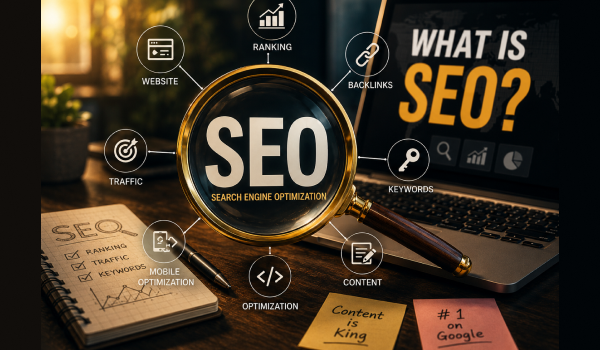
SEO (Search Engine Optimization) is the process of improving a website so it ranks higher in search engine results pages (SERPs) for relevant keywords and search queries.
In simple terms:
SEO helps your website appear when people search for topics, products, services, or questions related to your content.
For example:
If someone searches:
Search engines try to display the most relevant and useful results.
SEO helps your website become one of those results.
According to industry experts, SEO involves optimizing content, website structure, user experience, and authority signals so search engines can better understand and rank your pages.
Many businesses underestimate the power of organic search.
The reality is that most online experiences begin with a search engine.
When users need information, solutions, products, or services, their first step is usually Google.
Unlike ads that stop generating traffic when your budget runs out, SEO can continue driving visitors for months or even years.
That's why SEO remains one of the most valuable digital marketing strategies today.
To understand how SEO works, you first need to understand how search engines work.
Search engines follow three primary steps:
Search engines use automated bots called crawlers or spiders.
These bots scan websites and discover pages by following links.
Think of them as digital explorers constantly searching the internet for new content.
After discovering a page, search engines store information about it in their database.
This process is called indexing.
If your page isn't indexed, it won't appear in search results.
When someone performs a search, Google analyzes billions of pages and ranks the most relevant results.
Ranking decisions are based on hundreds of factors including:
Pages that provide the best experience and answers typically rank higher.
On-page SEO focuses on optimizing elements directly on your website.
Examples include:
Good on-page SEO helps search engines understand your content more effectively.
Technical SEO improves your website's infrastructure.
Important factors include:
Technical SEO ensures search engines can access and understand your website efficiently.
Off-page SEO focuses on external factors that influence rankings.
This includes:
When authoritative websites link to your content, search engines view your site as more trustworthy.
Local SEO helps businesses appear in location-based searches.
Examples:
Local SEO relies heavily on:
Keywords are words and phrases users type into search engines.
Examples:
Keyword research helps identify what your audience is searching for.
Once identified, these keywords can be naturally incorporated into:
The goal isn't keyword stuffing.
The goal is relevance.
One of the biggest SEO mistakes beginners make is focusing only on keywords.
Modern SEO is about understanding search intent.
Search intent refers to the reason behind a user's search.
Users want information.
Example:
"What is SEO?"
Users want a specific website.
Example:
"Facebook login"
Users are researching options.
Example:
"Best SEO tools"
Users are ready to take action.
Example:
"Buy SEO software"
Successful SEO aligns content with the user's intent.
While Google uses hundreds of ranking signals, some factors matter more than others.
Helpful, relevant, and trustworthy content consistently performs better.
Links from reputable websites signal authority.
Fast-loading, mobile-friendly websites tend to rank higher.
Google emphasizes:
Pages that fully answer a user's question often outperform competitors.
Many people confuse SEO with Google Ads.
Here's the difference:
| SEO | Paid Ads |
| Organic traffic | Paid traffic |
| Long-term results | Immediate results |
| Builds authority | Stops when budget ends |
| Lower long-term cost | Continuous spending |
The strongest digital marketing strategies often combine both.
If you're new to SEO, start with these fundamentals:
Focus on solving real problems.
Use tools like:
Make them clear and compelling.
A slow website hurts rankings and user experience.
Connect related pages across your website.
Create content worth referencing and sharing.
Most searches now happen on mobile devices.
Many websites fail because of avoidable mistakes.
Using the same keyword excessively.
Publishing low-value articles.
Broken pages and slow websites hurt rankings.
Copying content can negatively impact visibility.
Ranking isn't useful if visitors don't find what they need.
SEO continues to evolve.
Today, search engines prioritize:
While algorithms change, one thing remains consistent:
Websites that genuinely help users tend to win.
SEO stands for Search Engine Optimization. It is the process of improving a website so it appears higher in Google and other search engine results.
SEO helps increase organic traffic, improve visibility, generate leads, and build long-term authority online.
Most websites begin seeing results within 3 to 6 months, although competitive industries may take longer.
SEO itself doesn't require paying search engines, but tools, content creation, and professional SEO services may involve costs.
The four major types are:
Yes. Anyone can learn SEO by understanding search intent, creating valuable content, optimizing websites, and following SEO best practices.