
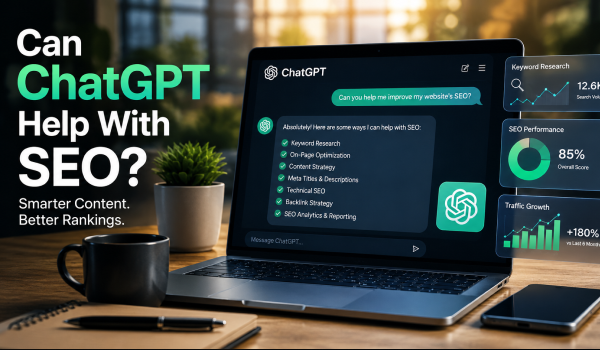
Many marketers and business owners are asking the same question: Can ChatGPT Help With SEO? As artificial intelligence becomes a bigger part of digital marketing, tools like ChatGPT are transforming how SEO professionals research keywords, create content, and optimize websites.
However, there is also a lot of confusion. Some people believe ChatGPT can completely automate SEO, while others think it has little value beyond content writing. The reality lies somewhere in between.
ChatGPT can significantly improve productivity by assisting with content creation, keyword clustering, topic ideation, meta descriptions, FAQs, and SEO planning. However, it cannot replace professional SEO expertise, technical analysis, or real-time SEO tools.
In this guide, you'll learn exactly how ChatGPT helps with SEO, its biggest advantages, limitations, and the best ways to use it effectively.
Yes, ChatGPT can help with SEO by assisting with keyword research, content creation, content optimization, title generation, meta descriptions, FAQs, and topic ideation. However, it should be used as a support tool rather than a complete replacement for SEO expertise and professional SEO software.
ChatGPT is an AI-powered language model developed by OpenAI that can generate human-like text based on prompts. It can answer questions, create content, summarize information, brainstorm ideas, and assist with various marketing tasks.
For SEO professionals, ChatGPT acts like a productivity assistant. Instead of spending hours brainstorming content ideas or drafting outlines, marketers can use AI to accelerate the process. While it doesn't replace strategy, it can significantly reduce the time required for repetitive tasks.
The short answer is yes.
ChatGPT can assist with many SEO-related activities, including content planning, keyword clustering, FAQ generation, title creation, and content optimization. It helps marketers work faster and generate ideas more efficiently.
However, ChatGPT doesn't have direct access to search engine algorithms, real-time ranking data, or competitor analytics. Therefore, it works best when combined with human expertise and dedicated SEO tools.
ChatGPT can generate dozens of keyword ideas based on a broad topic. For example, if your niche is fitness, it can suggest keywords related to workouts, nutrition, weight loss, and muscle building. This helps marketers discover potential content opportunities faster. While the suggestions should be validated using SEO tools, they provide an excellent starting point for research.
Long-tail keywords are often easier to rank for and attract highly targeted traffic. ChatGPT can generate variations of primary keywords that match specific user intent. These keywords can help create content that answers precise questions and improves conversion potential. Always verify search volume and competition before targeting them.
One of ChatGPT's biggest strengths is content ideation. It can quickly suggest blog topics based on industry trends, customer pain points, and search intent. This helps eliminate writer's block and ensures a steady content pipeline. Marketers can use these ideas to build comprehensive content calendars.
A well-structured article improves readability and SEO performance. ChatGPT can generate logical outlines with H2 and H3 headings that align with user intent. This saves planning time and helps writers cover important subtopics. A strong outline also improves topical authority.
ChatGPT can create initial drafts for blog posts, landing pages, and informational content. These drafts provide a strong foundation that writers can refine and enhance. Although human editing is necessary, AI-generated drafts significantly reduce writing time. This allows marketers to focus more on strategy and optimization.
Many articles suffer from thin content and incomplete explanations. ChatGPT can help expand sections with additional details, examples, and supporting information. This can improve content depth and increase the likelihood of satisfying search intent. However, accuracy should always be reviewed before publishing.
Meta titles play a crucial role in attracting clicks from search results. ChatGPT can generate multiple title variations optimized for target keywords and click-through rates. Marketers can test different options to find the most compelling version. Strong titles improve both rankings and user engagement.
Writing unique meta descriptions for dozens of pages can be time-consuming. ChatGPT can quickly create optimized descriptions that summarize content and encourage clicks. These descriptions can improve visibility in search results and support better user engagement.
FAQ sections help answer common user questions and improve content relevance. ChatGPT can generate question-and-answer pairs based on search intent and customer concerns. This not only enhances user experience but also creates opportunities for featured snippets and People Also Ask rankings.
Technical or complex content can be difficult for readers to understand. ChatGPT can rewrite complicated explanations into simpler language without losing meaning. This improves readability, engagement, and overall content quality.
Search engines prioritize content that users can easily understand. ChatGPT can shorten long sentences, improve transitions, and simplify language. Better readability often leads to longer engagement times and lower bounce rates. This contributes to a stronger overall user experience.
ChatGPT can analyze a topic and suggest missing subtopics that should be included in the content. Filling these gaps helps create more comprehensive articles that better satisfy user intent. Comprehensive content often performs better in competitive search results.
ChatGPT cannot accurately provide live keyword volumes, ranking positions, or search trends. For this information, marketers should use specialized SEO tools such as Google Search Console, Ahrefs, or Semrush. Real-time data is essential for making informed SEO decisions.
Technical SEO involves analyzing website performance, crawlability, indexing issues, and site architecture. ChatGPT can explain technical concepts but cannot perform full audits on its own. Dedicated SEO software is still required for accurate technical analysis.
No AI tool can guarantee first-page rankings. Search engine algorithms evaluate hundreds of ranking factors, including authority, backlinks, user experience, and content quality. ChatGPT can assist with optimization, but rankings ultimately depend on overall SEO execution.
ChatGPT automates repetitive tasks such as brainstorming, drafting, and content structuring. This allows SEO professionals to focus more on strategy and performance analysis. Time savings can significantly improve productivity across large content projects.
Businesses that publish content consistently often see better SEO results. ChatGPT helps teams create content faster without starting from scratch every time. This supports scalable content marketing efforts.
AI can generate fresh perspectives, unique content angles, and new topic ideas. This helps marketers overcome creative blocks and discover opportunities they may have otherwise missed.
Always fact-check AI-generated content before publishing. While ChatGPT is helpful, it can occasionally provide outdated or inaccurate information. Human review is essential for maintaining credibility and trust.
Use ChatGPT alongside professional SEO platforms rather than replacing them. AI excels at content creation, while SEO tools provide critical data such as rankings, backlinks, and keyword metrics.
The most successful SEO content satisfies user intent. Use ChatGPT to create helpful content that solves real problems rather than simply inserting keywords. Search engines increasingly reward user-focused content.
ChatGPT cannot directly improve rankings, but it can help create optimized content, generate keyword ideas, and improve content quality. These activities can indirectly contribute to better SEO performance when combined with proper optimization strategies.
ChatGPT is useful for brainstorming keyword ideas and generating long-tail variations. However, keyword data should always be validated using dedicated SEO tools to ensure accuracy and competitiveness.
No. ChatGPT can automate certain tasks, but it cannot replace strategic thinking, technical SEO expertise, or data-driven decision-making. Human oversight remains essential.
Google focuses on content quality rather than how content is created. AI-generated content is acceptable if it is helpful, accurate, original, and satisfies user intent.
Use ChatGPT for brainstorming, outlining, drafting, content optimization, and FAQ generation while relying on SEO tools and human expertise for strategy and validation.
So, Can ChatGPT Help With SEO? The answer is a clear yes. ChatGPT can streamline many SEO tasks, including keyword research, content planning, content creation, meta descriptions, FAQs, and optimization.
However, it should be viewed as a productivity tool rather than a complete SEO solution. Successful SEO still requires strategy, technical expertise, accurate data, and human oversight.
When combined with professional SEO tools and best practices, ChatGPT can help marketers create better content faster, improve efficiency, and scale SEO efforts more effectively. If used correctly, it can become a valuable addition to any modern SEO workflow.