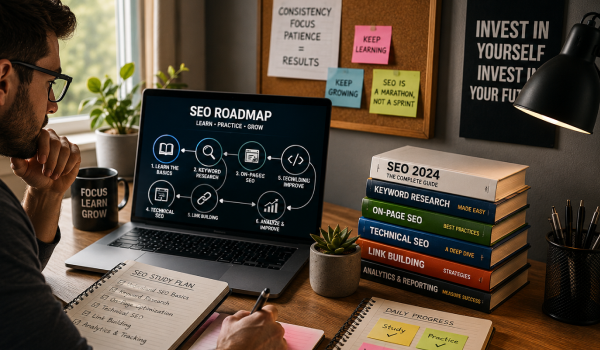
A few years ago, learning SEO felt intimidating.
There were technical terms everywhere.
People talked about algorithms, backlinks, indexing, crawling, and ranking factors as if everyone already understood them.
For many beginners, SEO seemed like a skill reserved for marketing experts and tech professionals.
But here's the truth:
Most successful SEO professionals started exactly where you are today.
They weren't born knowing keyword research or technical SEO. They learned step by step through curiosity, experimentation, mistakes, and practice.
If you're wondering can you learn SEO on your own, the answer is a resounding yes.
In fact, many of the world's best SEO specialists are self-taught.
The key isn't finding a secret formula. The key is following a structured learning path and applying what you learn consistently.
This guide will show you exactly how to do that.
Yes, you can learn SEO on your own. Thousands of marketers, freelancers, bloggers, and business owners have successfully taught themselves SEO using free resources, hands-on practice, and real-world experimentation. The fastest way to learn SEO is to combine education with practical implementation on your own website or project.
Many beginners assume SEO is highly technical.
While advanced SEO can become complex, the fundamentals are surprisingly straightforward.
At its core, SEO is about helping search engines understand your content and helping users find the information they need.
When you understand that principle, everything else starts making sense.
Think of SEO like learning to drive.
At first, everything feels overwhelming.
Over time, actions that once seemed complicated become second nature.
SEO works the same way.
Before diving into tactics, learn the basics.
Understand:
These concepts form the foundation of SEO.
Without understanding how search engines operate, advanced strategies won't make sense.
SEO is not a single skill.
It consists of several areas:
Optimizing content and page elements.
Improving website infrastructure.
Building authority through backlinks and brand signals.
Optimizing for location-based searches.
Understanding these categories helps organize your learning journey.
One of the biggest mistakes beginners make is relying solely on random advice.
Instead, learn directly from Google.
Google's Search Central documentation provides trustworthy guidance and helps you understand what search engines actually value.
Keyword research is one of the most important SEO skills.
It helps you understand:
This knowledge influences every SEO decision.
Reading alone won't make you good at SEO.
The fastest way to learn is by doing.
Start:
Your website becomes your SEO laboratory.
Many beginners focus too much on keywords.
Successful SEO focuses on users.
Ask:
Understanding intent improves rankings and engagement.
Whenever you search a keyword, analyze the results.
Notice:
Google already shows what it considers valuable.
Learn from it.
Every beginner should learn:
These skills provide some of the quickest SEO wins.
Technical SEO often scares beginners.
The good news?
You don't need to learn everything immediately.
Start with:
Build deeper technical knowledge over time.
Backlinks remain one of Google's strongest trust signals.
Understand:
Avoid shortcuts and spam tactics.
Great SEO learning doesn't require expensive software.
Start with:
| Tool | Purpose |
| Google Search Console | SEO performance |
| Google Analytics | Traffic analysis |
| Google Trends | Search trends |
| Rank Math | On-page optimization |
| Ahrefs Webmaster Tools | Site audits |
These tools help you learn through real data.
The SEO industry changes constantly.
Follow trusted sources such as:
This helps you stay updated and avoid outdated advice.
SEO is not a skill you master overnight.
Consistency beats intensity.
Spending 30 minutes daily for six months is often more effective than cramming for a weekend.
Focus on fundamentals first.
Prioritize users instead of chasing every update.
Knowledge without implementation creates little progress.
Many excellent SEO resources are available for free.
SEO rewards patience.
The timeline varies.
2–4 weeks
3–6 months
1–2 years of consistent practice
The good news is you don't need to become an expert before seeing results.
Many beginners improve website traffic within their first few months of learning.
Absolutely.
SEO remains one of the most valuable digital skills because it helps:
As long as people use search engines, SEO will remain relevant.
Yes. Many free resources, tools, and guides provide everything needed to learn SEO fundamentals and advanced concepts.
SEO has a learning curve, but beginners can understand the basics relatively quickly with consistent study and practice.
Most people develop foundational SEO skills within a few weeks and intermediate skills within three to six months.
Yes. SEO remains a high-demand skill across industries and offers opportunities in freelancing, agencies, in-house marketing, and consulting.
The fastest approach combines studying SEO fundamentals with hands-on practice on your own website.
No. Basic HTML knowledge helps, but many successful SEO professionals have limited coding experience.
Absolutely. Many business owners learn SEO to improve visibility, attract customers, and reduce advertising costs.
So, can you learn SEO on your own?
Without a doubt, yes.
You don't need a marketing degree, expensive certification, or years of formal training to start learning SEO.
What you need is curiosity, consistency, and a willingness to experiment.
Start with the fundamentals, build your own website, practice regularly, and focus on helping users solve real problems.
Over time, you'll develop one of the most valuable digital skills available today.
Whether your goal is growing a business, becoming a freelancer, building a blog, or launching a digital marketing career, learning SEO on your own can be one of the smartest investments you make in your future.