
Have you ever searched for something on Google and wondered why certain websites appear at the top while others are buried on page 10?
The answer is usually SEO.
If you're new to digital marketing, blogging, or online business, you've probably heard people talk about SEO as if it's some secret formula. The truth is much simpler.
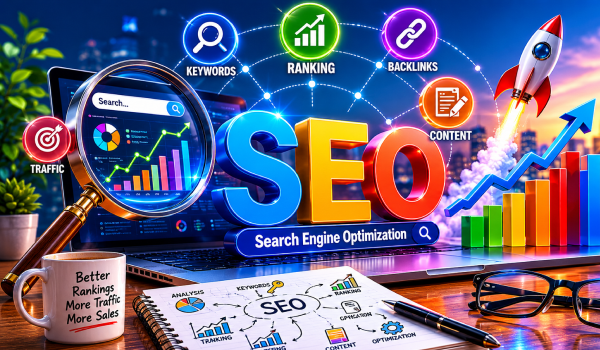
SEO stands for Search Engine Optimization, and it's one of the most important skills anyone can learn if they want more visibility online.
Whether you're a blogger, business owner, freelancer, or content creator, understanding SEO can help you attract more visitors without paying for ads.
In this guide, you'll learn exactly what SEO means, how it works, why it's important, and how beginners can start using it effectively.
It is the process of improving a website so that search engines like Google can understand, index, and rank it higher in search results. The goal of SEO is to increase organic (free) traffic by helping users find the most relevant content for their searches.
SEO stands for Search Engine Optimization.
Let's break it down:
| Term | Meaning |
| Search Engine | Platforms like Google, Bing, and Yahoo |
| Optimization | Improving something for better performance |
| SEO | Improving a website so it ranks higher in search results |
In simple words:
SEO helps search engines understand your website and helps users find your content.
Think of Google as a giant library.
Every day, billions of webpages compete for attention. SEO helps Google determine which pages deserve to be shown first when someone searches for information.
Imagine you own a coffee shop.
Someone nearby searches:
"Best coffee shop near me"
Google instantly analyzes millions of pages and decides which businesses should appear first.
SEO helps improve your chances of being one of those results.
Generally, search engines follow three major steps:
Search engines use bots to discover web pages.
The discovered pages are stored in Google's database.
Google evaluates relevance, quality, authority, and user experience before displaying results.
Many people think SEO is only for large companies.
That's not true.
Even a small local business can benefit from SEO.
Instead of paying for every visitor through ads, SEO helps attract visitors naturally.
People generally trust websites that appear on the first page of Google.
Modern SEO focuses heavily on:
Unlike paid advertising, a well-optimized page can continue attracting traffic for months or even years.
On-page SEO focuses on elements inside your website.
Examples include:
Example:
If your article is about "healthy breakfast recipes," your content should clearly discuss that topic and answer user questions.
Off-page SEO focuses on building authority.
Examples include:
Think of backlinks as recommendations.
When trusted websites link to your content, search engines view your website as more credible.
Technical SEO focuses on website infrastructure.
Key factors include:
Even great content may struggle to rank if technical issues prevent Google from accessing it.
Let's say Sarah starts a baking blog.
Initially, she publishes recipes without understanding SEO.
Her articles receive almost no traffic.
Then she learns basic SEO:
Six months later, her recipe pages begin ranking on Google.
Traffic increases.
More readers discover her content.
Some even purchase her baking course.
That's the power of SEO.
Using the same keyword repeatedly makes content look unnatural.
Ranking isn't about keywords alone.
You must satisfy what users actually want.
Short, low-value articles rarely perform well.
Most searches now happen on mobile devices.
SEO is a long-term strategy.
It often takes months to see significant improvements.
Answer real questions people are searching for.
Write for humans first.
Fast websites create better user experiences.
Clear titles help both users and search engines.
Connect related content throughout your website.
Ensure pages work well on phones and tablets.
Build authority through valuable content and outreach.
Years ago, SEO often focused on manipulating rankings.
Today, Google rewards:
This shift aligns with Google's emphasis on high-quality content and user satisfaction. Modern SEO is less about tricks and more about helping people find useful information.
SEO stands for Search Engine Optimization, the process of improving a website's visibility in search engine results.
SEO is the practice of helping your website appear higher on Google when people search for relevant topics.
SEO helps businesses and websites attract organic traffic, build trust, and generate leads without paying for every visitor.
No. Beginners can learn SEO fundamentals relatively quickly, although mastering SEO requires ongoing practice and learning.
Most websites begin seeing meaningful improvements within three to six months, depending on competition and strategy.
The three primary types are:
SEO itself doesn't require paying for clicks, but tools, content creation, and professional expertise may involve costs.
Yes. SEO remains one of the most effective digital marketing strategies for generating long-term organic traffic.
So, what does SEO stand for?
SEO stands for Search Engine Optimization, the process of improving a website's visibility in search engines like Google so more people can find it organically.
While the term sounds technical, the core idea is simple: create valuable content, provide a great user experience, and help search engines understand your website.Whether you're building a blog, growing an online business, or learning digital marketing, understanding Search Engine Optimization is one of the most valuable skills you can develop. Start with the basics, stay consistent, and remember that successful SEO is ultimately about helping people find the answers they're looking for.