Many websites struggle to rank not because of poor content quality, but because their content doesn't match what users actually want.
For example, someone searching for "best SEO tools" expects comparisons and recommendations. If they land on a page explaining the history of SEO, they will likely leave immediately.
This mismatch occurs when marketers ignore keyword intent.
Understanding What Is Keyword Intent helps you create content that aligns with user expectations, improves engagement, increases conversions, and supports better SEO performance.
Google's goal is to provide the most relevant result for every search query. If your content satisfies the intent behind a keyword, your chances of ranking improve significantly.
In this guide, you'll learn the different types of keyword intent, how to identify them, and how to use intent-driven SEO strategies to attract the right audience.
Keyword intent refers to the purpose or goal behind a user's search query. It explains why someone searches for a keyword and what type of information, product, service, or solution they expect to find in the search results.
Keyword intent, often called search intent or user intent, describes the reason behind a search query.
When someone enters a keyword into Google, they usually have a specific objective. They may want to learn something, compare options, visit a website, or make a purchase.
Google analyzes these objectives and ranks pages that best satisfy the user's intent.
For example:
| Keyword | Likely Intent |
| What is SEO | Learn information |
| Best SEO tools | Compare options |
| Ahrefs login | Visit website |
| Buy SEO software | Make purchase |
Understanding intent helps marketers create content that aligns with user expectations.
Google's algorithms are designed to match search queries with the most relevant content. Even a well-written article may struggle to rank if it fails to satisfy the intent behind the keyword.
When users find exactly what they need, they stay longer, engage more, and interact with content. These positive signals help reinforce content quality and relevance.
Not all searches indicate the same level of interest. Some users are gathering information, while others are ready to make a purchase.
Understanding keyword intent helps businesses target users at different stages of the customer journey.
Visitors who find content aligned with their goals are more likely to subscribe, request quotes, or complete purchases.
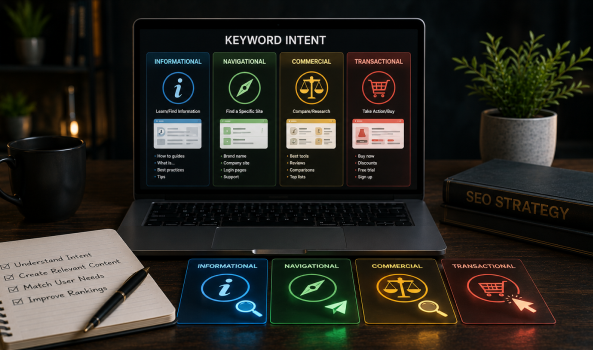
Informational searches occur when users are looking for answers, explanations, tutorials, or educational content. These searches are often made early in the buyer's journey.
Examples:
Informational intent is best served through:
Navigational searches occur when users already know where they want to go. They use Google as a shortcut to reach a specific website, platform, or page.
Examples:
For navigational keywords, users typically expect:
Commercial searches occur when users are researching products or services before making a final decision. They are evaluating alternatives and looking for recommendations.
Examples:
Commercial intent is often served by:
Transactional searches indicate strong buying intent. Users are prepared to purchase, subscribe, book, or complete another conversion-focused action.
Examples:
Transactional intent works best with:
| Intent Type | Goal | Example Keyword | Best Content |
| Informational | Learn | What is SEO | Blog Post |
| Navigational | Find Website | Ahrefs Login | Homepage |
| Commercial | Compare | Best SEO Tools | Comparison Guide |
| Transactional | Buy | Buy SEO Software | Product Page |
One of the easiest ways to identify keyword intent is to examine the current search results.
If most results are:
Google is already showing what users expect.
Keywords often contain words that signal intent.
| Modifier | Intent |
| How, What, Why | Informational |
| Best, Top, Review | Commercial |
| Buy, Order, Hire | Transactional |
| Login, Website, Contact | Navigational |
These modifiers provide valuable clues during keyword research.
Users move through different stages before making decisions.
Example:
| Stage | Search |
| Awareness | What is SEO? |
| Research | Best SEO tools |
| Comparison | Ahrefs vs Semrush |
| Purchase | Buy SEO software |
Understanding this journey helps marketers create content for every stage.
| Keyword | Intent |
| What is SEO | Informational |
| SEO Checklist | Informational |
| Best SEO Tools | Commercial |
| Ahrefs Pricing | Commercial |
| Hire SEO Agency | Transactional |
| Semrush Login | Navigational |
| Keyword | Intent |
| Running Shoe Reviews | Commercial |
| Buy Running Shoes Online | Transactional |
| Nike Official Website | Navigational |
| How to Clean Running Shoes | Informational |
Many beginners prioritize search volume and ignore intent.
However, intent often has greater business value.
| Metric | Search Volume | Keyword Intent |
| Measures | Demand | User Goal |
| Focus | Traffic | Relevance |
| Importance | High | Very High |
| SEO Impact | Strong | Critical |
| Conversion Influence | Moderate | High |
A keyword with 500 searches and transactional intent may generate more sales than a keyword with 10,000 informational searches.
If users want comparisons, create comparison content. If they want tutorials, create step-by-step guides. Matching content type to intent is essential.
Users want quick answers. Providing immediate value improves engagement and increases the likelihood of satisfying search intent.
Calls to action should align with intent. Informational content may encourage newsletter signups, while transactional pages should focus on purchases or inquiries.
Creating a blog post for a transactional keyword often results in poor rankings because users expect product or service pages.
Google's search results often reveal keyword intent. Skipping SERP analysis can lead to incorrect content decisions.
High-volume keywords are useless if they don't align with business goals or user expectations.
Different intents require different content formats. A one-size-fits-all approach rarely works.
| Task | Complete |
| Analyze Search Results | ✅ |
| Identify Intent Type | ✅ |
| Check Intent Modifiers | ✅ |
| Match Content Format | ✅ |
| Optimize User Experience | ✅ |
| Include Relevant CTA | ✅ |
| Monitor Engagement Metrics | ✅ |
Keyword intent is the purpose behind a search query. It explains what users hope to achieve when searching for a specific keyword.
Keyword intent helps marketers create content that matches user expectations, improving rankings, engagement, and conversions.
The four primary types are informational, navigational, commercial, and transactional intent.
Analyze search results, review intent modifiers, and evaluate what type of content currently ranks for the keyword.
Yes. Google prioritizes content that best satisfies the intent behind a search query, making intent one of the most important SEO factors.
Understanding What Is Keyword Intent is essential for creating content that ranks and converts.
Rather than focusing solely on keywords, successful SEO strategies focus on the reasons behind searches. By identifying whether users want information, comparisons, navigation, or transactions, you can create content that aligns with their expectations.
When content matches intent, rankings improve, engagement increases, and conversions become more likely. That's why keyword intent remains one of the most important factors in modern SEO.
Remember: ranking is not just about targeting keywords—it's about satisfying the people behind those keywords.