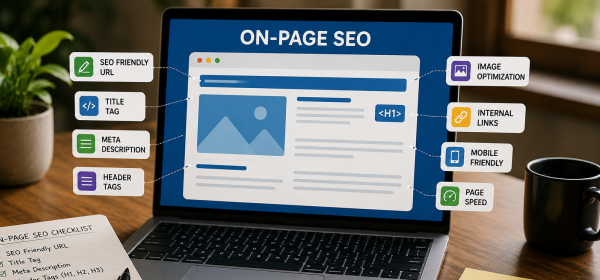
What Is On-Page SEO? On-Page SEO is the process of optimizing the elements on an individual webpage—including content, title tags, headings, URLs, images, internal links, and user experience—to help search engines understand the page and improve its rankings in organic search results.
If you've ever wondered why some websites consistently appear on the first page of Google while others struggle to gain visibility, the answer often starts with On-Page SEO.
Search engines evaluate hundreds of ranking factors, but the elements you control directly on your website have a major influence on how your pages perform. Even excellent content can fail to rank if it lacks proper optimization.
Learning What Is On-Page SEO helps you create webpages that are easier for search engines to crawl, understand, and rank. At the same time, it improves the experience for visitors by making your content more organized, relevant, and accessible.
Whether you're running a blog, an online store, or a business website, On-Page SEO forms the foundation of a successful SEO strategy. In this guide, you'll learn what it is, why it matters, and the essential elements every optimized webpage should include.
On-Page SEO is the practice of optimizing individual webpages so they can rank higher in search engines and provide a better experience for users. Unlike Off-Page SEO, which focuses on external signals such as backlinks, On-Page SEO involves improvements made directly on your website.
These improvements help search engines understand the purpose of your page while making it easier for visitors to consume the information. When your content is relevant, well-structured, and optimized, search engines are more likely to consider it valuable for users searching for related topics.
On-Page SEO consists of many different optimization techniques that work together to improve a webpage.
These include:
Each of these elements contributes to the overall quality of a webpage and plays a role in helping search engines understand its relevance.
On-Page SEO is more than simply adding keywords to a page. It helps search engines understand your content, improves usability, and increases the chances of earning higher rankings.
Search engines rely on various page elements to understand what your content is about. A clear title, logical heading structure, optimized images, and well-written content provide strong relevance signals.
Without proper optimization, Google may struggle to determine whether your page deserves to rank for a particular keyword.
Modern SEO is heavily focused on user satisfaction. Visitors expect webpages to load quickly, display correctly on mobile devices, and provide useful information in an easy-to-read format.
Good On-Page SEO naturally improves these areas by encouraging better formatting, faster performance, and logical navigation.
Well-optimized pages are more likely to appear for relevant search queries. Better visibility usually leads to more impressions, higher click-through rates, and increased organic traffic over time.
Instead of relying solely on paid advertising, On-Page SEO helps attract visitors consistently through search engines.
Unlike paid campaigns that stop generating traffic when your budget ends, On-Page SEO creates lasting value. Once a page is properly optimized and earns strong rankings, it can continue attracting visitors for months or even years with regular updates.
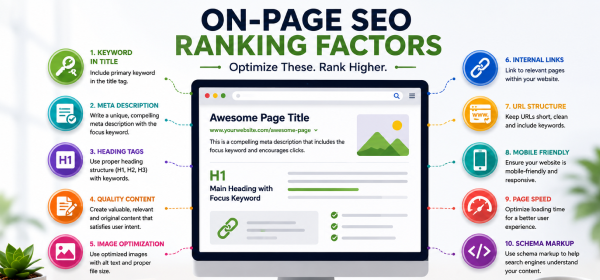
Search engines crawl webpages, analyze their content, and evaluate numerous ranking signals before deciding where a page should appear in search results.
On-Page SEO improves many of these signals, making it easier for search engines to understand and trust your content.
Google first discovers your webpage through links or sitemaps. It then crawls the page to analyze its structure, content, headings, images, and links.
Pages with clear organization and optimized HTML elements are generally easier to crawl and index.
Google compares your page with the user's search query.
It looks at:
The more effectively your page answers the user's question, the stronger its relevance signals become.
Search engines also evaluate how users interact with your pages.
Important experience factors include:
These factors contribute to a better overall page experience.
Successful On-Page SEO combines multiple optimization techniques rather than relying on a single ranking factor.
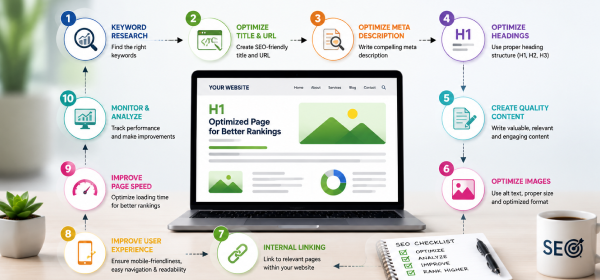
Content is the foundation of every successful SEO strategy. Your content should answer user questions completely, provide original insights, and demonstrate expertise.
Instead of writing only for search engines, focus on solving real problems. Comprehensive and useful content naturally performs better because it satisfies user intent.
Keywords help search engines understand the primary topic of your page. The focus keyword should appear naturally in important locations such as the title, introduction, headings, and conclusion.
Rather than repeating the same phrase excessively, use related terms and semantic keywords to build topical relevance.
The title tag is one of the strongest On-Page SEO signals. It should clearly describe the page while encouraging users to click.
A strong title tag should:
| Best Practice | Recommendation |
|---|---|
| Length | 50–60 characters |
| Primary Keyword | Near the beginning |
| Number | Include where relevant |
| Power Word | Yes |
| Positive Sentiment | Recommended |
| Unique | Every page |
Although meta descriptions are not direct ranking factors, they strongly influence click-through rates.
An effective meta description should summarize the page, include the focus keyword naturally, and explain the benefit users will receive by visiting your content.
A logical heading hierarchy improves readability for users and helps search engines understand the organization of your content.
Use:
| Heading | Purpose |
|---|---|
| H1 | Main page title (only one) |
| H2 | Main sections |
| H3 | Supporting topics |
Avoid skipping heading levels or using multiple H1 tags on the same page.
URLs should be short, descriptive, and easy to understand.
Example:
✅ yourdomain.com/what-is-on-page-seo
Avoid unnecessary numbers, symbols, or random characters that make URLs difficult to read.
Images improve engagement but should also support SEO.
Optimize every image by:
Optimized images improve both accessibility and page speed.
Internal linking is one of the most effective On-Page SEO techniques because it helps search engines discover your pages while guiding visitors to related content.
A well-planned internal linking strategy distributes page authority across your website and encourages users to explore more content. This can increase session duration, reduce bounce rates, and strengthen your site's topical authority.
Use internal links that are relevant to the topic rather than adding links randomly. Your anchor text should clearly describe the destination page instead of using generic phrases like "click here."
A strong internal linking strategy should:
External links point to trusted websites and resources that support your content. Linking to authoritative sources demonstrates credibility and helps users access additional information when needed.
External links should always be relevant to your topic. Avoid linking to low-quality or unrelated websites, as they can reduce user trust.
When adding external links, ensure they genuinely enhance the reader's understanding of the topic.
A few simple practices include:
Page speed directly affects both user experience and SEO. Visitors expect webpages to load quickly, and slow-loading pages often result in higher bounce rates and lower conversions.
Google also considers page experience signals, making performance optimization an important part of On-Page SEO.
Several optimizations can significantly improve loading times without changing your content.
Common techniques include:
Improving page speed benefits both users and search engines.
More than half of all searches now happen on mobile devices. Because of this, Google primarily evaluates the mobile version of a webpage when determining rankings.
A mobile-friendly website provides a better browsing experience across smartphones and tablets.
Ensure your website adapts to different screen sizes and remains easy to navigate.
Important considerations include:
A mobile-friendly website not only improves rankings but also increases user satisfaction.
Schema markup is structured data that helps search engines better understand your content. While it doesn't guarantee higher rankings, it can improve your visibility through rich results.
Rich results may include FAQs, ratings, breadcrumbs, product information, and other enhanced search features.
Depending on your content, you can implement different schema types.
Popular examples include:
| Schema Type | Best Used For |
|---|---|
| Article | Blog posts |
| FAQ | Frequently Asked Questions |
| Breadcrumb | Website navigation |
| Product | Ecommerce pages |
| Organization | Business websites |
| Local Business | Local SEO |
Structured data improves search appearance and can increase click-through rates.
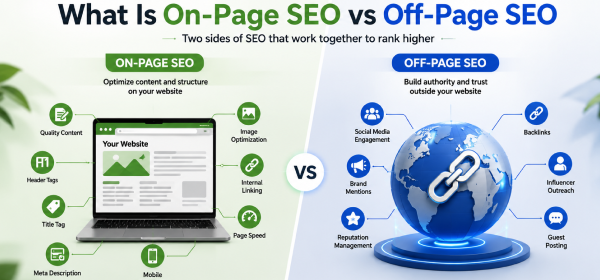
Although both are essential for successful SEO, they focus on different aspects of website optimization.
| Feature | On-Page SEO | Off-Page SEO |
|---|---|---|
| Focus | Website optimization | Website authority |
| Control | Full control | Limited control |
| Examples | Content, titles, headings, images | Backlinks, brand mentions, citations |
| Goal | Improve relevance | Build trust and authority |
| Time to Implement | Immediate | Long-term |
The strongest SEO strategies combine both On-Page and Off-Page optimization.
Optimizing your webpages provides long-term advantages beyond rankings.
Optimized pages are easier for search engines to understand, increasing the likelihood of appearing for relevant search queries.
Better rankings naturally generate more impressions and clicks from search engines.
Clear layouts, faster loading times, and structured content make your website easier to use.
Using headings, internal links, and logical formatting helps users find information quickly.
Optimized title tags and meta descriptions encourage more users to visit your website.
Publishing comprehensive, interconnected content helps establish expertise within your niche.
Search engines can understand and index well-optimized pages more efficiently.
Responsive webpages perform better across all devices.
Users who easily find the information they need are more likely to take action.
Unlike paid advertising, optimized pages can continue generating organic traffic for months or years.
Relevant, easy-to-read content encourages visitors to stay longer.
Strategic internal links help visitors discover more valuable resources.
Following On-Page SEO best practices naturally improves the quality and usefulness of your content.
Well-organized pages create a more professional impression for visitors.
On-Page SEO supports every other SEO activity, making it one of the most important parts of a long-term strategy.
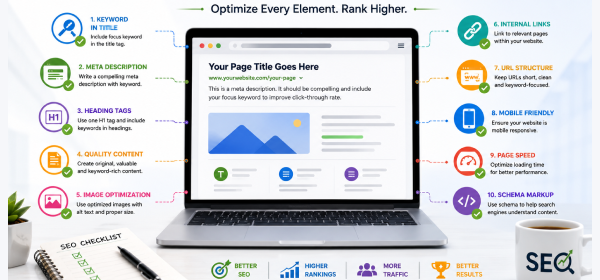
| Checklist Item | Status |
|---|---|
| Primary keyword researched | ✅ |
| Search intent analyzed | ✅ |
| One H1 only | ✅ |
| SEO title optimized | ✅ |
| Meta description written | ✅ |
| Keyword in introduction | ✅ |
| Proper H2 and H3 headings | ✅ |
| Helpful, original content | ✅ |
| Images optimized | ✅ |
| Internal links added | ✅ |
| External links added | ✅ |
| Mobile friendly | ✅ |
| Fast page speed | ✅ |
| HTTPS enabled | ✅ |
| Schema markup added | ✅ |
| URL optimized | ✅ |
| Content proofread | ✅ |
Repeating the same keyword too often creates unnatural content and reduces readability. Use related terms and semantic keywords instead of forcing exact matches.
Content that doesn't answer the user's question is unlikely to rank well, regardless of optimization.
Publishing duplicate or nearly identical pages can confuse search engines and weaken rankings.
Without internal links, visitors and search engines may struggle to discover related content.
A website that performs poorly on mobile devices often experiences lower engagement and weaker rankings.
Large images, excessive scripts, and poor hosting negatively affect page speed and user experience.
On-Page SEO is the practice of optimizing individual webpages to improve search engine rankings and user experience by enhancing content, HTML elements, images, links, and page performance.
It helps search engines understand your content, improves user experience, increases organic visibility, and supports long-term SEO growth.
Content quality, search intent, title tags, meta descriptions, headings, internal links, page speed, mobile responsiveness, and image optimization are among the most important factors.
Neither is better. On-Page SEO builds the foundation of your website, while Off-Page SEO improves authority through backlinks and external signals.
Review important pages every few months or whenever search rankings decline, search intent changes, or significant content updates are needed.
Yes. Faster pages improve user experience and support better search performance.
You may rank for low-competition keywords with excellent On-Page SEO. However, competitive industries usually require Off-Page SEO and technical optimization as well.
Absolutely. While search algorithms continue to evolve, optimizing your content and webpages remains a fundamental part of SEO.
Understanding What Is On-Page SEO is one of the most valuable steps you can take to improve your website's search performance. By optimizing your content, titles, headings, images, internal links, page speed, and mobile experience, you create webpages that are easier for both users and search engines to understand.
Remember that On-Page SEO is not a one-time task. As search trends, algorithms, and user expectations evolve, regularly reviewing and improving your pages will help maintain rankings and drive sustainable organic traffic. Combined with high-quality content and a strong overall SEO strategy, On-Page SEO provides the foundation for long-term online success.